
The Original Scary Line Graph: Let’s Listen to the “Tipping Point: The True Story of The Limits to Growth” Podcast! (April Fools 2024)

Myth’s Note: Sometimes, you have the right meme ready to go at the right place and the right time for both Science Sunday and April Fools! With an entire week coming up, I hope you'll give this podcast a listen. This thread-advertisement was originally published on Scary Line Day (April 1, 2024) for r/collapse. Let’s get started:
—

--
A few months ago, I had the good fortune to stumble across one of the most fascinating podcasts that I’ve ever discovered - Tipping Point: The True Story of "The Limits to Growth". It’s an extraordinarily detailed and well-researched true-crime-style podcast miniseries created by Katy Shields and Vegard Beyer, who describe their aural masterpiece as follows:
Tipping Point: The True Story of The Limits to Growth was the culmination of a four-year research effort to understand why humanity ignored the seminal 1972 book The Limits to Growth, and what we can learn from it. Based on late author Dana Meadows' unpublished memoirs and featuring rare original audio recordings, this podcast accompanies Dana and Dennis Meadows and their team of scientists on their mission to educate the world about coming ecological crises and their solutions.
For those looking for more context as to what the Limits to Growth study actually was, here’s a quick summary from Richard Heinberg:
The Limits to Growth at 50: From Scenarios to Unfolding Reality, Richard Heinberg
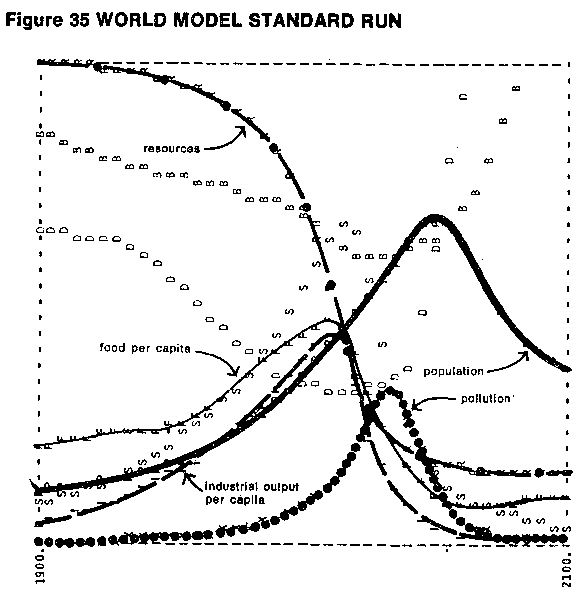
A half-century ago, the worlds of science, public policy, and economics were rocked by a prominent book, The Limits to Growth, authored by four systems scientists (Donella Meadows, Dennis Meadows, Jørgen Randers, and William Behrens III) from the Massachusetts Institute of Technology (MIT). The team produced computer-based scenarios showing that continued increases in population and industrial output would eventually prove to be unsustainable, and that the only path to a stable future was one in which levels of both population and industrial output were deliberately constrained by government policies. If growth continued, the crunch would not come immediately; the team’s “standard run” (or business-as-usual) scenario instead showed major disruptions to world systems commencing in the first half of the 21st century.
The Limits to Growth sold 12 million copies, was translated into 37 languages, and remains the top-selling environmental book ever published. However, prominent economists (including Robert Solow, Milton Friedman, and Julian Simon) bristled at the idea that growth might have limits, and issued rebuttals that, while failing to address the core arguments of the book, nevertheless were cited repeatedly over the following years as authoritative refutations (an excellent overview and history of the debate can be found in Ugo Bardi’s The Limits to Growth Revisited). The New York Times Book Review dismissed The Limits to Growth as “an empty and misleading work . . . garbage in, garbage out.” Newsweek (a far more influential publication then than now) called it “a piece of irresponsible nonsense.” Policy makers were happy to be relieved of the obligation to grapple with the book and its implications, and have essentially ignored it ever since.
(Myth's Note: The model standard run figure in Heinberg's piece might look familiar to the above image ... )
Sadly, the podcast has only enjoyed limited reception (around 20,000 streams and 100 reviews without a promotional budget) since its original release last year. Not surprisingly, they’ve reached out to their mailing list in the past to assist them with spreading the word. To quote them exactly from said e-mail:
The journey has been incredible so far. With close to 20,000 streams in just four months (without any promotional budget), endorsements from renowned thought leaders, and a place in university curricula worldwide, our podcast has begun to make waves about this important story. But we believe that this is just the beginning. Our primary goal remains – to ensure this crucial story reaches as wide an audience as possible. [...]
And now, with their previous requests in mind and with an unannounced Scary Line Day suddenly upon us, I felt that it was finally time to deploy today’s meme-advertisement; it's one that I’ve had waiting on my desktop for far too long. Think of this thread as one content creator giving their support to another, especially to those who enjoy educating others with their detailed research!
Today’s meme combines two sources: the first being an ABC Australia News Special from 1973 ... and the second, of course, being this absolutely wonderful narrative history that I wanted to share with you all today. As the week is just beginning, I really do hope you’ll give it a listen. The three episodes are as follows - note that they're all available on your music streaming service of choice:
-
Kicking off in Harvard in the late 1960s, Part 1 explores how young scientists found themselves thrust into one of the most controversial – but also prescient – scientific projects of all time.
-
Maybe We Did Want to Save the World (Part 2)
Part 2 dives into the serendipitous and somewhat chaotic circumstances that thrust the book, initially not intended as a book or for a large audience, into the global spotlight, and recounts the intense PR struggle that would ensue. (Myth's Note: This is when the podcast gets spicy.)
-
Where Are We Going, Really? (Part 3)
Part 3 takes a deep dive into how the researchers navigated the aftermath of their seminal publication, including their second attempt to warn the world in the 1990s, and track the post-2000 resurgence of interest in their work against the backdrop of escalating environmental crises.
--
And finally, for those who are more academically inclined, I’d like to give you all one last set of parting gifts – free PDF files for the Limits to Growth (1972, 1993, and 2004), along with those who carry on the great work. Please enjoy! :)
The Limits to Growth: A Report for the Club of Rome’s Project on the Predicament of Mankind (1972)
Beyond the limits : confronting global collapse, envisioning a sustainable future (1993)
Limits to Growth: The 30-Year Update (2004) -- (Synopsis here!)
Update to Limits to Growth: Comparing the World3 model with empirical data (2020), Gaya Herrington